Perhaps someday we may acknowledge that the most egregious damage inflicted by this technological age is the increased disassociation with a sense of place: the place we are born, where our ancestors are buried, where we live, where we travel. This disassociation from place is a precursor to an assault on our environment, on culture, and living things. Poetry has long been a vehicle for grounding us in a place both by close observation to the sights, sounds, smells, feel of a place and linking them to language and stories of that place, and by heightening our imagination and bestowing meaning beyond the physical. It is a reminder to pay attention, listen to, the particulars of a place, not just any bird but a specific bird experienced in context, that makes a place.
Mary Oliver is a contemporary master of this: here is her example with the Meadowlark Sings and I Greet Him in Return:
Meadowlark Sings and I Greet Him In Return
from New and Selected Poems (2017) , by Mary Oliver, Penguin Press
Meadowlark, when you sing it’s as if
You lay your yellow breast upon mine and say
Hello, hello, and are we not
Of one family, in our delight of life?
You sing, I listen.
Both are necessary
If the world is to continue going around
Night-heavy then light –laden, though not
Everyone knows this or at least
Not yet,
Or, perhaps, has forgotten it
In the torn fields,
In the terrible debris of progress
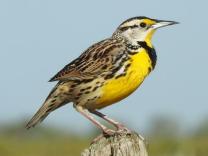
The most comprehensive archives of birds in the world is the Cornell Lab of Ornithology. This is where I found a picture of the meadowlark that Mary Oliver
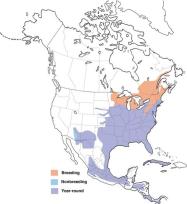 is referring to , and can hear and audio of its song. A bird whose numbers are “in decline”. I’m listening to the meadowlark now. I can see the map that shows where it can be found. But by doing this, do I get a sense of place? Do I both intellectually and emotionally connect to the “torn fields” where Oliver walks, listening, just by sitting in front of my computer thousands of miles away? Can I feel the same loss that she does, hearing the meadowlark sing on a recording? In pairing the poem to the archives, I feel closer to understanding of the meadowlark, the place it resides, and to some degree, my place in the world. Still, I’m reminded by this poem, there is no substitution for walking the fields and listening, of being quiet in that place.
Looking back, we may find the most comprehensive field guides and archives are our poetry books.
 STEM & Leaf